Rule-based automation can do a lot, but not everything. The steps that depend on someone reading content and deciding what happens next stayed manual. That is exactly where M-Files Custom Agents step in.
What is new
M-Files is launching a public beta of Custom Agents: AI-driven automation inside your M-Files workflows. The agent handles the workflow steps that depend on reading content and determining what happens next, work that rule-based automation could never touch. You decide where the agent acts and where people stay involved. Every outcome is recorded, with the reasoning behind it.
How it works
- Administrators configure agents with prompts in plain language. No code, no developer needed.
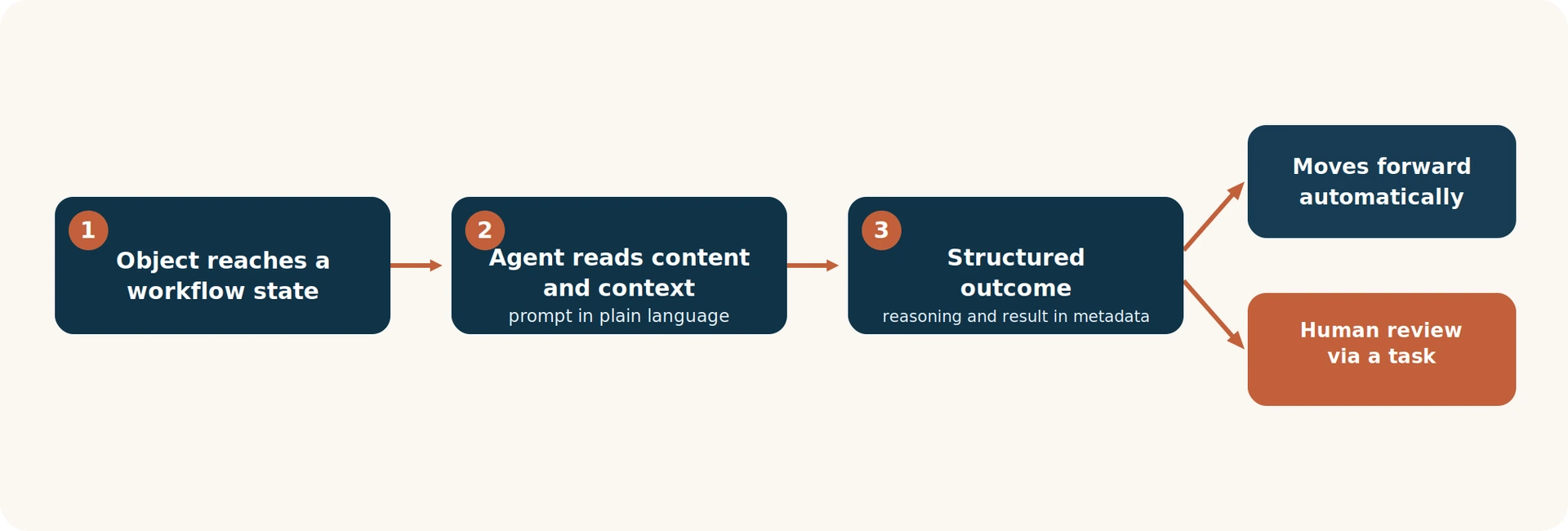
- When an object reaches a workflow state with an agent configured, the agent reads the available content and context and returns a structured outcome.
- The agent updates properties on the object, creates new related objects, or both.
- The reasoning behind every outcome sits directly on the object's metadata card.
What it gives you
- The right people on the right work. Steps that call for review and a decision no longer form a queue behind the people qualified to handle them.
- More work moves forward on its own. Steps that read content, apply rules and determine the next action can run automatically. Including work that used to need a manual review every time.
- Every outcome can be reviewed and explained. The reasoning sits next to the result. Process owners, reviewers and auditors can see how a conclusion was reached.
What it looks like in practice
Three examples from regulated environments, each with the agent at work inside the workflow.
Incoming inspection
The agent reads the inspection sheet alongside the product's design document, checks every required measurement against its tolerance, and flags any deviation. Sheets that are fully within tolerance move forward automatically. Every deviation goes to a person.
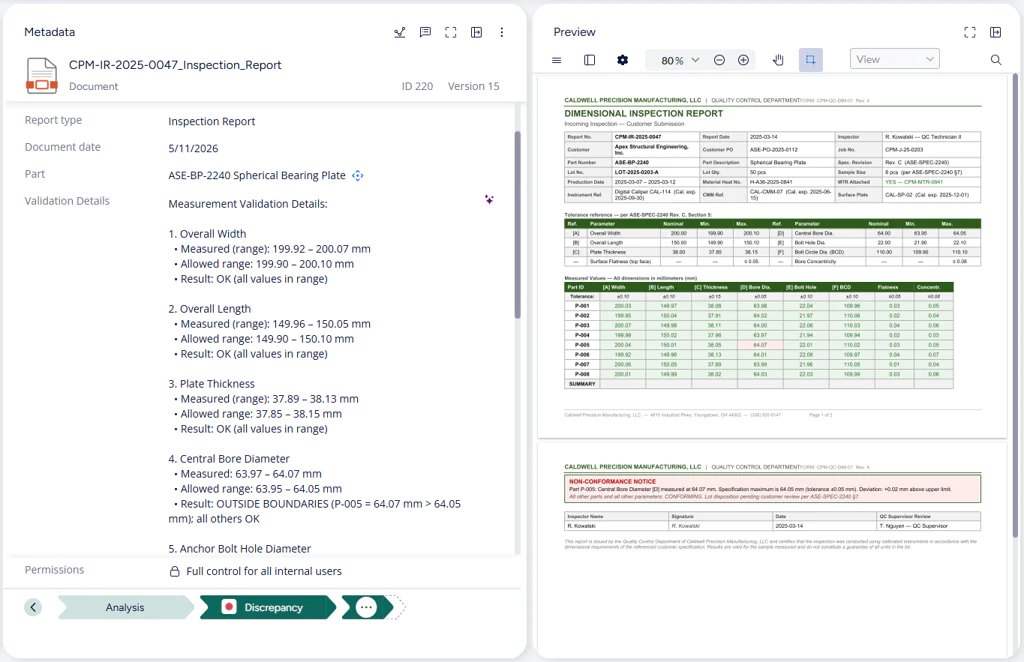
Example: inspection report for a spherical bearing plate. Part P-005 has a central bore diameter of 64.07 mm, just above the 64.05 mm upper limit. All other values conform. The agent moves the sheet from “Analysis” to “Discrepancy”.
Subcontractor invoice verification
The agent reads the invoice together with the linked contract and change order, and verifies that the billed roles, rates and amounts match. The approver receives a structured assessment instead of two documents to read side by side.
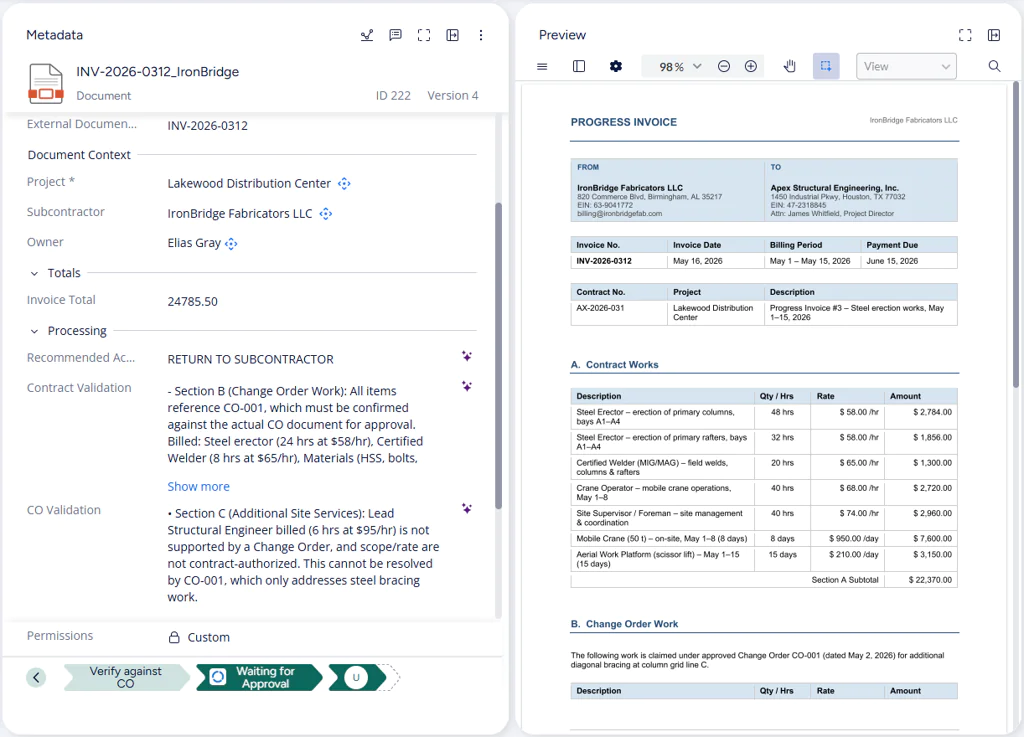
Example: progress invoice from subcontractor IronBridge Fabricators. Section C, additional services from a Lead Structural Engineer, is not covered by change order CO-001 and not contract-authorised. Recommended action: return to the subcontractor. State: “Verify against CO” to “Waiting for Approval”.
Vendor risk assessment
The agent assembles the risk picture from connected records: certifications, open non-conformances and contract status. It records a risk level with a short justification. Only vendors rated high move to a human review.
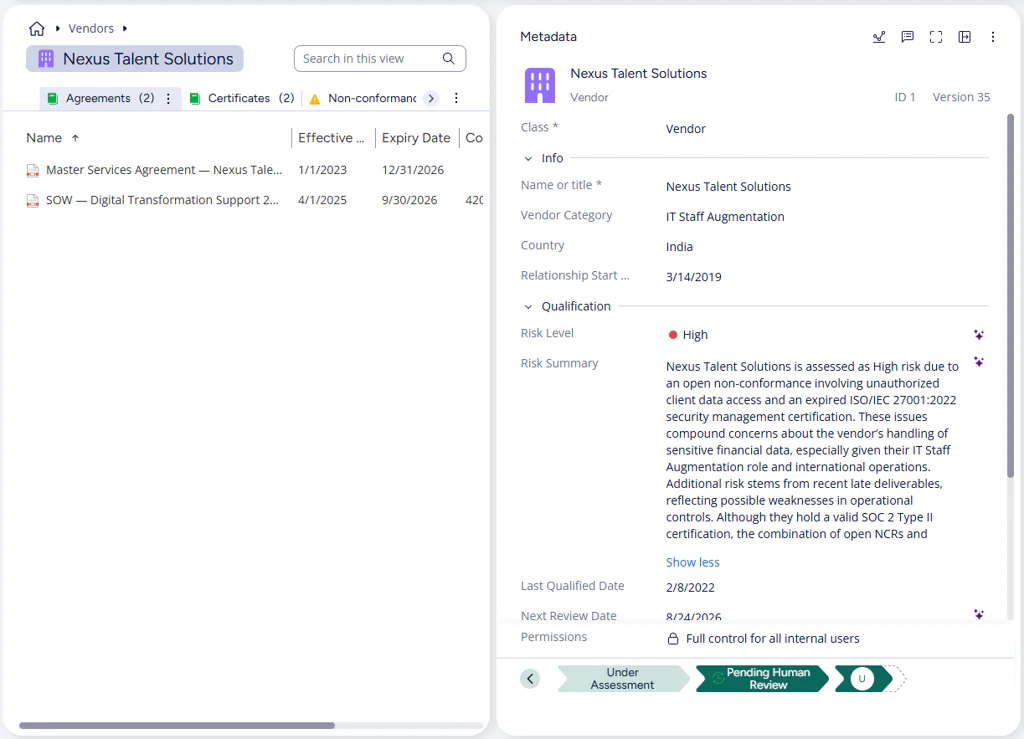
Example: vendor Nexus Talent Solutions. An open non-conformance around unauthorised access to client data and an expired ISO/IEC 27001:2022 certificate outweigh the valid SOC 2 Type II. Risk level: high. State: “Under Assessment” to “Pending Human Review”.
It also fits, among others, a contract compliance check (the contract against a defined set of requirements, with routing based on what is and is not met) and action item extraction from a meeting memo (an assignment object per action item, pre-filled with title, responsible person and deadline).
Governance is built in
Every outcome carries its reasoning. On the metadata card you can see why the agent reached a conclusion: which value it compared, which rule it applied, why something was flagged. That explanation stays in version history, even after a person changes the value.
For anyone working under the EU AI Act, that is not a detail. The Act requires AI used in professional decisions to be transparent, explainable and auditable. With M-Files, the explanation sits in the document itself, not in a separate report.
Does your setup qualify?
The beta has clear boundaries. Use this checklist.
- M-Files 26.6 or later
- An M-Files Cloud vault (on-premises is not supported)
- Edition M-Files Essentials (2026), Enterprise (2026) or Business (2022) Platform edition
- A separate vault application licence
During the public beta, Custom Agents is available at no extra cost.
Pricing after general availability will be announced separately.